

Not just the answer, but why
A phrase is read word by word, then its word order, then what it means and when to use it. Try it on a phrase from the restaurant:
Help is fine. A word you needed Explain for just comes back a little sooner.
Learn German on your phone
Each lesson is built from your answers: what you know, what you missed, and what you're ready for next.
No new account needed.
Wohnung
flat, apartment
One word, every facet. Tap one, or watch it turn.
Stuck? Every exercise and every phrase has Explain. It shows you how to think it through, one step at a time.
A phrase is read word by word, then its word order, then what it means and when to use it. Try it on a phrase from the restaurant:
Help is fine. A word you needed Explain for just comes back a little sooner.
This sentence
Entschuldigung, ist hier noch frei?
Word by word:
The parts of the sentence:
A yes/no question: the verb comes first, not second.
In the statement, the verb is part 2: Hier ist noch frei.
A linking word (und, aber, oder, denn), or a word in front set off by a comma (Ja, Entschuldigung, a name), does not count.
Ist hier noch frei: “is this seat free?”
Also on trains and in waiting rooms. Ist hier besetzt? asks the same the other way round.
You learn both, one step at a time.
Harder practice, new words along the way, and sentence building: build one sentence, then change it step by step. Make it negative, turn it into a question, add a modal verb, put it in the past.
We help you do all of that, one step at a time.
People talking in everyday situations. You complete each line by tapping the missing word.
The gaps can be worked out from the story so far, and the wrong words look alike, so you really read.
New words from the story come back in your Quick and Deep dive.
Wo ist mein Handy?
A1Every line has sound in the app.
Story complete
Paced like a good game: it builds up, then lets you breathe.
It adapts to you as you go. New words come a few at a time, and a word's plural and forms only once you know its meaning. Answer well and new words come sooner; when it gets hard, it slows down and brings back what you know. Not too easy, not too hard: just a little beyond what you know, so you keep improving. Each lesson is short, then a board with your numbers.
Every answer changes what comes next: a word you miss comes back soon, and new words wait until the ones before them hold.
Day 0: you learn a new word. Without reviews, it fades within days (the dashed line).
Chance you remember the word
19:00
An illustration: in the app, the timing adapts to each word and to how you answer.
Each one asks about a word and gives you the answer, so you learn something without even opening the app.
Only if you turn them on. With the spaced schedule, a word you learn comes back after 15 minutes, 2 hours and 5 hours, again before bed, then after 1, 3, 7 and 30 days. You forget fastest in the first hours; after that, the gaps grow.
Each one asks first and answers second, so it's a small test, not a nudge. Tap it, and the Quick dive opens on that word, asking what the notification asked.
Prefer fewer? Choose one word a day, or three. And none in your quiet hours at night.
Tap one to expand it
The spaced schedule for one word
Each word comes back just before you'd forget it, on a schedule based on research.
Behind it is FSRS, an open-source spaced-repetition algorithm based on research. It keeps track of every facet of every word, so you don't have to.
Its meaning, its article, its plural and its verb forms each come back on their own spaced-repetition schedule (FSRS, based on research), just before you would forget them.
So you can know what a word means and still practise its plural.
das Haus
Based on research on the forgetting curve (Ebbinghaus 1885; Murre and Dros 2015), retrieval practice (Karpicke and Roediger 2008), spacing (Cepeda et al. 2006, 2008) and sleep (Gais et al. 2006; Mazza et al. 2016). FSRS is open source, from the open-spaced-repetition project. Not a guarantee: everyone learns at their own pace.
A word that won't stick? Tap the bolt, and it gets a few exercises of its own, right there in the lesson.
The bolt sits in the corner of the card. Tap it, and the lesson adds a few exercises on just that word, easy to hard, each from a different side.
Then it rests: it comes back once more at the end of the lesson, and after that on its own schedule, like every word.
Want more? 5 more, harder keeps going with harder ones.
An example. In the app, the exercises depend on the word and on how you answer.
Ready for your first lesson?
Download Facet DeutschEvery learner hits the same walls. Here is what Facet Deutsch does about each one.
Every noun comes in its colour, with its article, from the first time you see it. And when there is a rule, Explain shows it.
die Wohnung
flat, apartment
How to think
1The ending -ung always makes die.
Explain on every exercise shows how to think it through, step by step. Case quizzes show why der becomes dem: mit takes the Dativ.
Ich fahre mit dem Zug.
mit takes the Dativ, so der becomes dem.
FSRS brings each word back just before you'd forget it. If you want, notifications quiz you between lessons.
Every lesson mixes new words, reviews and surprises, and keeps changing how it asks.
A dozen kinds of questions, mixed for you:
Build a sentence, then change it: negative, question, past. Explain numbers the parts, so you see where the verb goes and why.
The second verb part goes to the end: the two parts frame the sentence.
Everyday German decks and phrases for real situations, from the Anmeldung to the doctor, each with Explain.
Phrases for everyday situations:
Open the app and you're in the first one, already practising.
Quick dive
Know the word. Know the article. Know why.
Why is it der Zug but mit dem Zug? Case quizzes ask for the article inside a real sentence. Then the case panel shows you the reason: mit takes the Dativ, so der becomes dem.
Gender questions stay about der, die or das. Cases get their own quizzes, so you learn one thing at a time.
Which article fits?
Ich fahre mit Zug.
Learn the words you'll hear, with the article you'll need.
Decks for everyday situations, learned in order, from the Anmeldung to the doctor. And phrases for everyday situations, each with Explain.
All of it teaches German, not legal, tax or medical advice.
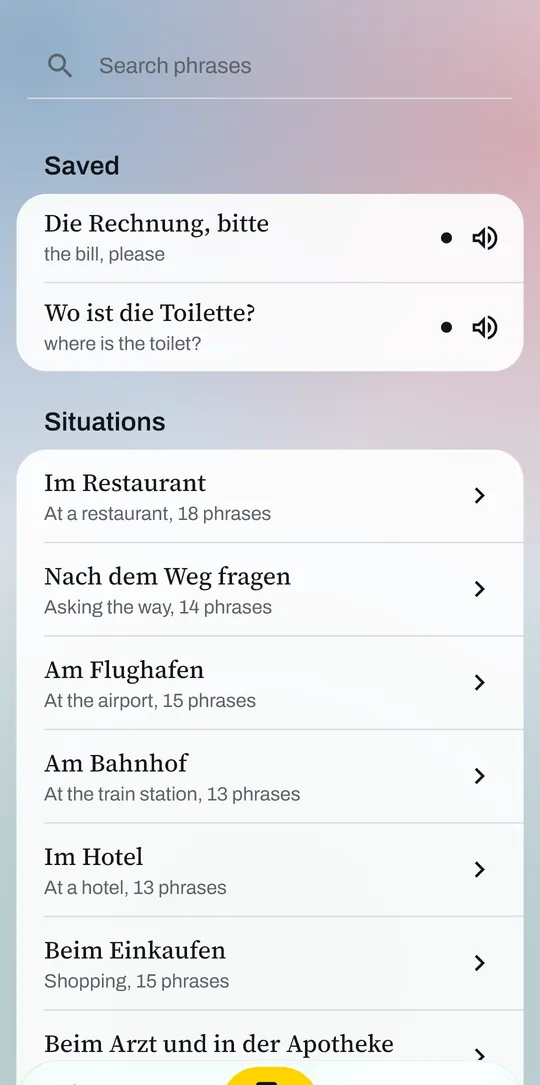
Find the phrase you need
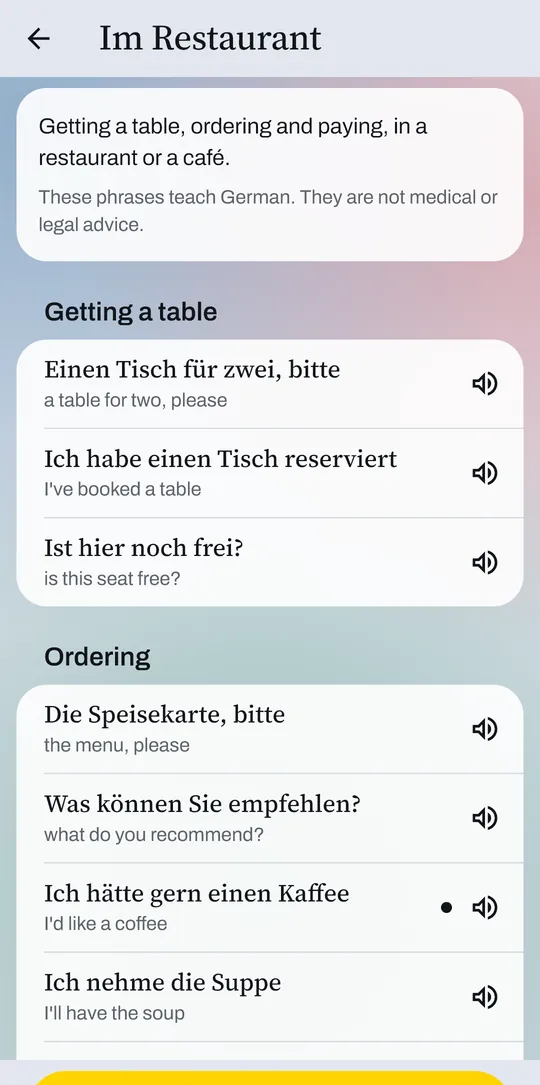
In the order you'll need them
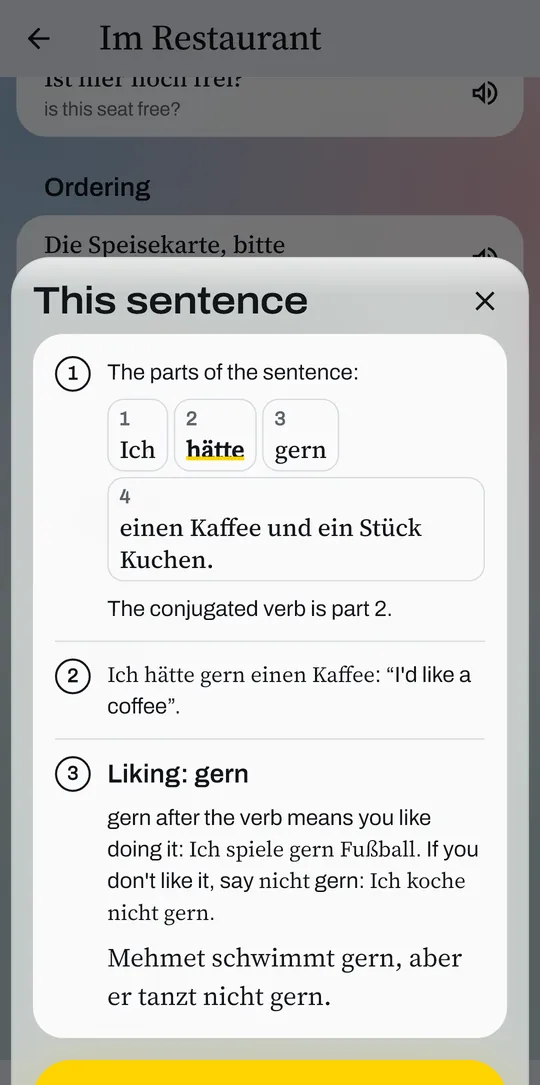
Every phrase with Explain
A short check at the start adapts to you, and every word you miss, you learn on the spot. It gives you a quick estimate of where to start.
You picked “house”, but that's not it. It's “door”. Now this word is yours.
die Tür
door
Explain splits a sentence into its parts. Tap one, and it shows why that part stands there.
Explanations in English, Portuguese (Brazil) or Turkish. Pick one when you start, and change it any time in Settings.
On a computer? Scan this with your phone's camera to get the app.
die Brücke
Every level from A1 to C2, each with its words, example sentences and grammar exercises.
Explanations in English, Portuguese (Brazil) or Turkish. Pick one when you start, and change it any time in Settings.
Right after you choose your language, the app asks how much German you know. New to it? A short tour starts you off with Hallo, der, die, das and your first sentence: Ich heiße and your name. Know some already? A short check at the start adapts to you, and every word you miss, you learn on the spot. It gives you a quick estimate of where to start.
No new account needed: the app store account on your phone is enough. We never ask for your email.
When you start, the app asks how much time a day suits you, and you can change your pace later in Settings. Each lesson is short. A little every day works better than a lot once a week.
Phones with Android 7.0 or newer, and iPhone and iPad with iOS 15 or newer.
Yes, as an estimate. Facet & You shows level estimates as you learn, on the CEFR scale that German exams use. They come from your answers: estimates, not exam results.